 Aerial Media
 Inspections
 Mapping & Survey
 Agriculture & Specialty
In Michigan, the FAA controls the airspace and requires a Part 107 certificate for any commercial flight. State law preempts most local drone ordinances, criminalizes drone harassment and privacy invasion, bans using drones to take or recover game, and adds MDARD licensing for aerial pesticide application. The DNR restricts drones on state-managed land.
The three layers of drone law
Every drone flight in Michigan answers to three layers at once: federal aviation rules (who may fly, where and how high), state statutes (privacy, hunting, preemption, pesticides) and land-manager rules (where you may take off and land, such as DNR land, universities, the Capitol and private property).
Federal: FAA Part 107
- Commercial pilots need a Remote Pilot Certificate (Part 107) and must keep it current with recurrent online training every 24 months.
- Registration and Remote ID are required for commercial drones.
- Altitude: 400 ft above ground level, or within 400 ft of a structure.
- Controlled airspace around Detroit Metro (Class B), Lansing, Grand Rapids, Flint and Kalamazoo (Class C) and towered airports like Ann Arbor, Willow Run and Jackson (Class D) requires authorization, typically through LAANC. See our Michigan airspace map.
- Stadium restrictions: flights are prohibited within 3 nautical miles and below 3,000 ft of major stadiums (Michigan Stadium, Spartan Stadium, Ford Field, Comerica Park) from one hour before to one hour after qualifying events.
- Operations over people and at night are allowed only under specific Part 107 conditions.
Michigan’s Unmanned Aircraft Systems Act & preemption
Michigan’s Unmanned Aircraft Systems Act (2016 PA 436, MCL 259.301 et seq.) is the state framework. Its key feature is preemption: MCL 259.305 generally prevents cities, villages and townships from passing their own rules on drone ownership or operation. Local governments can still regulate their own drone use, and general laws (trespass, nuisance, privacy) still apply.
The Act also allows anyone authorized by the FAA to fly commercially in Michigan if they operate consistent with federal law, and it prohibits interfering with first responders and flights over correctional facilities.
Privacy & harassment
MCL 259.322 makes it illegal to use a drone to harass another person, to violate a personal protection order, or to capture photos or audio of someone where they have a reasonable expectation of privacy. Violations are misdemeanors (MCL 259.323), punishable by up to 90 days in jail and a $500 fine. Shooting down a drone is a federal felony (18 U.S.C. § 32).
Professional practice in Michigan: get permission to launch, notify neighbors for close work and frame shots to avoid private spaces like windows, fenced yards and pools.
Hunting, fishing & deer recovery
MCL 324.40111c prohibits taking game or fish with an unmanned aircraft, and MCL 324.40112 prohibits using one to interfere with lawful hunting or fishing. The Michigan DNR’s hunting regulations go further: using a drone to locate or recover game, dead or wounded, counts as take, even after legal hours and even on private land.
A federal challenge by Drone Deer Recovery and its founder (Yoder v. Bowen) was dismissed, and the Sixth Circuit affirmed on July 31, 2025. So drone deer recovery remains illegal in Michigan. We keep a launch list in case that changes. Leashed tracking dogs remain a legal recovery option under DNR rules.
Off-season terrain and habitat mapping that does not locate game is a separate activity. See hunting land & habitat mapping.
Agricultural spraying
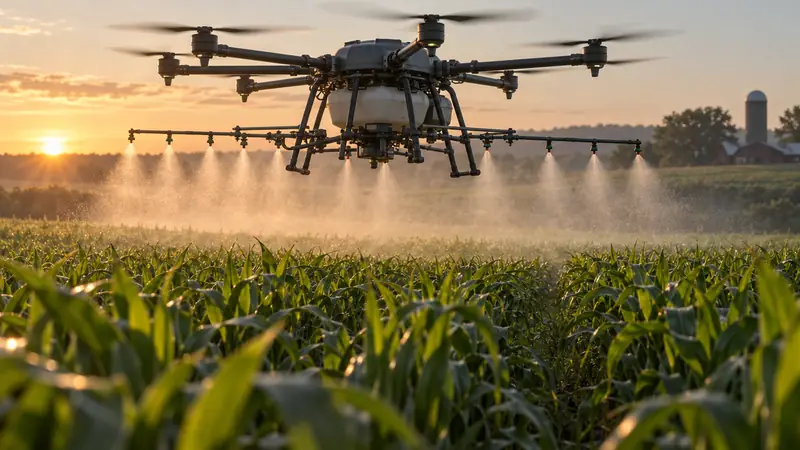
Dispensing pesticides (and some fertilizers) from an aircraft is an agricultural aircraft operation under FAA Part 137. Spray drones over 55 lb also need an FAA exemption (49 U.S.C. 44807). In Michigan, MDARD adds pesticide applicator certification, aerial applicator requirements and a Pesticide Application Business License (PABL) for anyone soliciting or performing applications for hire.
State parks & public land
The DNR’s Land Use Orders (Order 5.1 and related orders) restrict drone launches and operations on state-managed land, prohibit them in certain locations and require written DNR permission for commercial operations in state parks and recreation areas. Huron-Clinton Metroparks, county parks, universities (such as the University of Michigan’s UAS policy) and the State Capitol grounds have their own rules.
Pending legislation to watch: SHIELD
The bipartisan SHIELD package (Securing Homeland and Infrastructure with Emerging Laws for Drones), introduced in late 2025 as a set of about 15 House bills, would create no-drone zones over critical infrastructure, expand authority to disable drones, create a state geofencing app and restrict state purchases of drones from companies of concern. As of late 2026, the House had passed two procurement bills (HB 5329 and HB 5331). Most of the operational provisions had not been enacted. We’ll update this guide as bills move.